Showing posts with label Report. Show all posts

Wednesday, November 9, 2011

Future of Media: Lots of Questions, But No Easy Answers

Future of Media: Lots of Questions, But No Easy Answers

The Columbia School of Journalism released a massive report on Tuesday that looks at the current landscape of digital media — the small and the large, the mainstream and the alternative — and finds what will come as no surprise to anyone familiar with the industry:disruption and confusion, and a notable lack of any obvious solutions. Although there are hints of some possible new business models, the bottom line is that journalists and media companies simply don’t understand enough about what is happening to their traditional business. And until they do, the chaos is likely to continue.
The study (which is available as a PDF document here) is broken down into nine sections, which give an overview of some of the major trends that have been impacting the media business — including the rise of aggregators such as The Huffington Post, the fact that online advertising produces a lot less revenue per user than traditional media does, the various experiments with news paywalls (“many efforts to get readers to pay for content have been fitful, poorly executed and motivated more by ideology than economics”) and the rise of low-cost competitors such as Examiner.com. And all of this in the context of an explosion of information, as described by journalism professor Vin Crosbie:
Within the span of a single human generation, people’s access to information has shifted from relative scarcity to surplus.
The report also looks at some of the alternative models that media organizations are trying both on the hyper-local level — via community sites such as The Batavian in upstate New York, which is virtually a one-man operation run by Howard Owens — and at national publications such as Forbes, which has been blurring the line between editorial and marketing content in a way that some traditional journalists may find troubling. But while some publishers are having some success with new ventures such as Groupon-style “daily deals” platforms and other experiments, there are few signs of a silver bullet solution that will make it easy for existing media companies to transition from their old way of doing business to a new one.
As Clay Shirky has said, the problem we suffer from now isn’t information overload, it’s “filter failure.” That should leave plenty of room for media companies and journalists to act as filters and curators for this information onslaught — and many are doing this, including Andy Carvin at NPR. But how do media companies monetize this? And can it ever produce enough revenue to make up for the loss of the old business model? Those are the questions that media entities everywhere are struggling with.
The report notes that despite its massive online readership, the old print business still produces 80 percent of the revenue for The New York Times — and one reason why those large reader numbers don’t produce much revenue is that the majority of those readers are “flybys” who rarely spend much time on the site and don’t return very often.
As Felix Salmon of Reuters notes in his analysis of the study, the fundamental issue for all media companies is that the traditional connection between their content and the advertising that pays for the infrastructure needed to produce that content — the buildings and staff and trucks and satellite time — has been disrupted. In the past, media companies controlled the platform, whether it was the newspaper or the magazine or the TV network, and advertisers paid to have their messages inserted into that platform. The study notes:
Digital disrupts the aggregation model that was so profitable for so long. Almost no one used to read the entire newspaper every morning, and audiences frequently tuned in and out of the network news at night. Yet, news organizations sold their advertising as if every page was turned and every moment was viewed.
This is all part of the broader trend of media disintermediation, or what Om calls “the democracy of distribution.” The web — and social-media tools such as Twitter and Facebook and YouTube — allow information to flow freely and to be published instantly by non-traditional journalists in non-traditional ways. But so far media companies have yet to figure out how to deal with this in any concrete way. Even though these trends have become obvious by now, and individual journalists such as Andy Carvin and Nick Kristof at The New York Times are exploring how to use these tools to create and distribute powerful journalism, few media outlets have made these new processes a part of their business.
So far, the most ambitious attempts to reinvent the business of media on a large scale have come from companies like the Journal-Register Co., where CEO John Paton is pushing an ambitious “digital first” approach and has cut costs dramatically. But in a way, the company is more equipped to make these kinds of aggressive moves because it went bankrupt before Paton took over.That gave the company a lot of leeway to reinvent and try new things.
Other media entities have to figure out how to reinvent their businesses without effectively starting with a clean slate, and that is much more difficult. The only thing the Columbia report makes clear is that they have to do it somehow and quickly; if anything, the disruption in the industry is accelerating. Which is why experimentation is so important — unfortunately, experimentation is not something the traditional media business is known for.
Post and thumbnail photos courtesy of Flickr users Zert Sonstige and Zarko Drincic

Report: World headed for irreversible climate change in five years


  • guardian.co.uk
  • Article history
Pollution due to carbon emissions due to rise says IEA : Coal burning power plant, Kentucky, USA
Any fossil fuel infrastructure built in the next five years will cause irreversible climate change, according to the IEA. Photograph: Rex Features
Energy demandEnergy demand Source: IEA
The world is likely to build so many fossil-fuelled power stations, energy-guzzling factories and inefficient buildings in the next five years that it will become impossible to hold global warming to safe levels, and the last chance of combating dangerous climate change will be "lost for ever", according to the most thorough analysis yet of world energy infrastructure.
Anything built from now on that produces carbon will do so for decades, and this "lock-in" effect will be the single factor most likely to produce irreversible climate change, the world's foremost authority on energy economics has found. If this is not rapidly changed within the next five years, the results are likely to be disastrous.
"The door is closing," Fatih Birol, chief economist at the International Energy Agency, said. "I am very worried – if we don't change direction now on how we use energy, we will end up beyond what scientists tell us is the minimum [for safety]. The door will be closed forever."
If the world is to stay below 2C of warming, which scientists regard as the limit of safety, then emissions must be held to no more than 450 parts per million (ppm) of carbon dioxide in the atmosphere; the level is currently around 390ppm. But the world's existing infrastructure is already producing 80% of that "carbon budget", according to the IEA's analysis, published on Wednesday. This gives an ever-narrowing gap in which to reform the global economy on to a low-carbon footing.
If current trends continue, and we go on building high-carbon energy generation, then by 2015 at least 90% of the available "carbon budget" will be swallowed up by our energy and industrial infrastructure. By 2017, there will be no room for manoeuvre at all – the whole of the carbon budget will be spoken for, according to the IEA's calculations.
Birol's warning comes at a crucial moment in international negotiations on climate change, as governments gear up for the next fortnight of talks in Durban, South Africa, from late November. "If we do not have an international agreement, whose effect is put in place by 2017, then the door to [holding temperatures to 2C of warming] will be closed forever," said Birol.
But world governments are preparing to postpone a speedy conclusion to the negotiations again. Originally, the aim was to agree a successor to the 1997 Kyoto protocol, the only binding international agreement on emissions, after its current provisions expire in 2012. But after years of setbacks, an increasing number of countries – including the UK, Japan and Russia – now favour postponing the talks for several years.
Both Russia and Japan have spoken in recent weeks of aiming for an agreement in 2018 or 2020, and the UK has supported this move. Greg Barker, the UK's climate change minister, told a meeting: "We need China, the US especially, the rest of the Basic countries [Brazil, South Africa, India and China] to agree. If we can get this by 2015 we could have an agreement ready to click in by 2020." Birol said this would clearly be too late. "I think it's very important to have a sense of urgency – our analysis shows [what happens] if you do not change investment patterns, which can only happen as a result of an international agreement."
Nor is this a problem of the developing world, as some commentators have sought to frame it. In the UK, Europe and the US, there are multiple plans for new fossil-fuelled power stations that would contribute significantly to global emissions over the coming decades.
The Guardian revealed in May an IEA analysis that found emissions had risen by a record amount in 2010, despite the worst recession for 80 years. Last year, a record 30.6 gigatonnes (Gt) of carbon dioxide poured into the atmosphere from burning fossil fuels, a rise of 1.6Gt on the previous year. At the time, Birol told the Guardian that constraining global warming to moderate levels would be "only a nice utopia" unless drastic action was taken.
The new research adds to that finding, by showing in detail how current choices on building new energy and industrial infrastructure are likely to commit the world to much higher emissions for the next few decades, blowing apart hopes of containing the problem to manageable levels. The IEA's data is regarded as the gold standard in emissions and energy, and is widely regarded as one of the most conservative in outlook – making the warning all the more stark. The central problem is that most industrial infrastructure currently in existence – the fossil-fuelled power stations, the emissions-spewing factories, the inefficient transport and buildings – is already contributing to the high level of emissions, and will do so for decades. Carbon dioxide, once released,stays in the atmosphere and continues to have a warming effect for about a century, and industrial infrastructure is built to have a useful life of several decades.
Yet, despite intensifying warnings from scientists over the past two decades, the new infrastructure even now being built is constructed along the same lines as the old, which means that there is a "lock-in" effect – high-carbon infrastructure built today or in the next five years will contribute as much to the stock of emissions in the atmosphere as previous generations.
The "lock-in" effect is the single most important factor increasing the danger of runaway climate change, according to the IEA in its annual World Energy Outlook, published on Wednesday.
Climate scientists estimate that global warming of 2C above pre-industrial levels marks the limit of safety, beyond which climate change becomes catastrophic and irreversible. Though such estimates are necessarily imprecise, warming of as little as 1.5C could cause dangerous rises in sea levels and a higher risk of extreme weather – the limit of 2C is now inscribed in international accords, including the partial agreement signed at Copenhagen in 2009, by which the biggest developed and developing countries for the first time agreed to curb their greenhouse gas output.
Another factor likely to increase emissions is the decision by some governments to abandon nuclear energy, following the Fukushima disaster. "The shift away from nuclear worsens the situation," said Birol. If countries turn away from nuclear energy, the result could be an increase in emissions equivalent to the current emissions of Germany and France combined. Much more investment in renewable energy will be required to make up the gap, but how that would come about is unclear at present.
Birol also warned that China – the world's biggest emitter – would have to take on a much greater role in combating climate change. For years, Chinese officials have argued that the country's emissions per capita were much lower than those of developed countries, it was not required to take such stringent action on emissions. But the IEA's analysis found that within about four years, China's per capita emissions were likely to exceed those of the EU.
In addition, by 2035 at the latest, China's cumulative emissions since 1900 are likely to exceed those of the EU, which will further weaken Beijing's argument that developed countries should take on more of the burden of emissions reduction as they carry more of the responsibility for past emissions.
In a recent interview with the Guardian recently, China's top climate change official, Xie Zhenhua, called on developing countries to take a greater part in the talks, while insisting that developed countries must sign up to a continuation of the Kyoto protocol – something only the European Union is willing to do. His words were greeted cautiously by other participants in the talks.
Continuing its gloomy outlook, the IEA report said: "There are few signs that the urgently needed change in direction in global energy trends is under way. Although the recovery in the world economy since 2009 has been uneven, and future economic prospects remain uncertain, global primary energy demand rebounded by a remarkable 5% in 2010, pushing CO2 emissions to a new high. Subsidies that encourage wasteful consumption of fossil fuels jumped to over $400bn (£250.7bn)."
Meanwhile, an "unacceptably high" number of people – about 1.3bn – still lack access to electricity. If people are to be lifted out of poverty, this must be solved – but providing people with renewable forms of energy generation is still expensive.
Charlie Kronick of Greenpeace said: "The decisions being made by politicians today risk passing a monumental carbon debt to the next generation, one for which they will pay a very heavy price. What's seriously lacking is a global plan and the political leverage to enact it. Governments have a chance to begin to turn this around when they meet in Durban later this month for the next round of global climate talks."
One close observer of the climate talks said the $400bn subsidies devoted to fossil fuels, uncovered by the IEA, were "staggering", and the way in which these subsidies distort the market presented a massive problem in encouraging the move to renewables. He added that Birol's comments, though urgent and timely, were unlikely to galvanise China and the US – the world's two biggest emittters – into action on the international stage.
"The US can't move (owing to Republican opposition) and there's no upside for China domestically in doing so. At least China is moving up the learning curve with its deployment of renewables, but it's doing so in parallel to the hugely damaging coal-fired assets that it is unlikely to ever want (to turn off in order to) to meet climate targets in years to come."
Christiana Figueres, the UN climate chief, said the findings underlined the urgency of the climate problem, but stressed the progress made in recent years. "This is not the scenario we wanted," she said. "But making an agreement is not easy. What we are looking at is not an international environment agreement — what we are looking at is nothing other than the biggest industrial and energy revolution that has ever been seen

Report: Teens, Kindness and Cruelty on Social Network Sites


Teens, Kindness and Cruelty on Social Network Sites


How American teens navigate the new world of "digital citizenship"

The Pew Research Center’s Internet & American Life Project released a new study on November 9, 2011 at FOSI’s Annual Conference. "Teens, Kindness and Cruelty on Social Network Sites" was conducted by the Pew Internet Project in partnership with FOSI and with the support of Cable in the Classroom. This study explores the unique issues teens face when using social networking sites as well as where they turn to receive advice about how to use the Internet safely and responsibly.


Key Findings


1. Parents generally feel their children are safe online, but  parents with younger children are more confident in their child's online safety than are those with older children.Top concerns about online safety relate to children's personal safety online.

  • Online safety is not a heightened concern among parents, with a large majority (86%) reporting they  feel  their child is very  (42%) or somewhat safe (44%) online. Just 13% of parents say their child is very  (3%) or somewhat (10%) unsafe when it comes to their online activities.
  • The proportion of parents who feel  their child is "very safe" decreases the  older the  child and the  more time he or she  spends online. 
  • Among parents of children ages  14  to 17,  38% feel their child is "very safe" online, versus 52% among parents of children ages  eight to 10  who feel the  same. 
  • More than half of parents of light Internet users (one to four hours/ week) feel "very safe" when their child is online, while confidence is lower (33% feel  child is very  safe)  among parents of children who spend 10 or more hours online per  week.
  • When it comes to various online activities, parents express the  most concern about their children viewing sexually explicit content online (70% veryI somewhat concerned). 
  • Communicating with a stranger online (61%) and  visiting Web  sites  with inappropriate content (61%) also  are  top  concerns expressed by parents, all of which relate to the personal safety of a child.
  • Parents say that they  rely  most on  the  news media (38%), other parents (37%), and schools or teachers (29%) for  information about how to best protect their child's safety and  privacy online.

2.  The  computer is the  most ubiquitous means by which children go online, but  half of parents say their children access the  Internet using other platforms.

  • Nearly all (96%) parents surveyed say their children access the  Internet using  a computer, laptop, or netbook.
  • Half  (51%) report their child uses  something in addition to a computer to access the  Internet, versus 49% whose children only  use  a computer. When it comes to children's usage  of other devices to go online, 30% use a gaming console, 27% use a handheld device, and  21% use a smartphone.
  • Nearly half (48%) of parents say their children use  two or more technologies, and  24% of parents say their child uses  three or more devices to access the  Internet.
3.  Parents feel  more knowledgeable about ways  to protect their children's safety and  privacy online using a computer than they do when it comes to protecting their safety while using newer Internet platforms-such as smartphones and handheld devices.

  • Three in four (75%) parents feel  very  (44%) or fairly  (31%) knowledgeable about protecting their child's online safety and  privacy when he or she is using  a computer.
  • Among parents whose children use  a gaming console to go online (30% of sample), nearly two-thirds (62%) say they  are  very  or fairly  kuowledgeable about safety protections. More than half (55%) of parents whose children use a smartphone or handheld device (48% of sample) express this  level  ofkuowledge.

4. Virtually all parents (96%) say they have talked to their children about their behavior and  the  risks and  benefits of being online, and  just over half of parents say they have used parental controls for  Internet use.


  • Fifty-three percent (53%) of parents say they  have  used  tools or software to monitor or limit their children's Internet activity. Use  of parental controls is higher among mothers (57%), parents under age 40  (59%), parents who completed postgraduate work/ degree (62%), and parents who use social media (60%).
  • A large majority (87%) of parents report awareness of at least  one of the  five  types oflnternet parental controls tested.
  • Parental controls offered by software companies such  as Norton, McAfee, and  Microsoft are most widely known, with two-thirds (67%) of parents reporting awareness. Programs and tools offered by Internet service providers such  as phone and  cable companies also  are  widely kuown (60% report awareness). Awareness of tools from search engines (48%), video game companies (37%), and  wireless phone companies (35%) is lower.

5.  Among parents who do  not use  parental controls, the  most oft-cited reason is that parents feel  they are unnecessary.

  • Among parents who have not used  parental controls (46% of sample), most report online safety tools and  programs are  not necessary, either because of rules and  limits already in place (60%), and/ or because they  trust their child to be safe (30%). 
  • Parents are  notably less likely  to attribute their non-use of these tools to a lack  of understanding of how to use  them (14%), a lack  of awareness of them (8%), concern about their cost  (7%), or doubts about their effectiveness (6%).
  • Just 27% of parents say they  chose not to use  parental controls because of a lack  of knowledge or concern about cost. Mothers (35%), parents age  50  and  over (33%), parents with a high school education or less  (37%), and  yearly incomes at or below $50,000 (32%) are  more likely to say knowledge or cost prevented them from using  parental controls to monitor their child's Internet usage.

6.  Parents report monitoring their children's Internet usage in a variety of ways.

  • Of all 18 methods queried, setting rules or limits for online behavior were most common. Large proportions of parents also report blocking or actively monitoring their child's Internet usage across various platforms.
  • Nearly all (93%) parents say they  have  set  rules or limits in one or more ways  to safeguard their children online. Among parents whose children use the  computer to access the  Internet (96% of sample), 79% report setting rules that  allow their children to use the  computer only in common areas of the  house. Three in four (75%) parents set rules about the  amount of time children can  spend online or the  time of day children can  be online (74%).
  • When asked about six specific parental control technologies, a large majority (65%) of parents report using  one or more of them, including those provided by computer operating systems, online search engines, Internet service providers, videogame consoles, or smartphones. 
  • The use of parental control technologies for  smartphones is least  common. Among the  21% of parents whose children use  a smartphone to access the  Internet, one in four says they  have  set up smartphone parental controls, and  16% have  dov.Tiloaded a parental control app. One-third of parents whose children access the  Internet using  a video game console (30% of the  sample) have  used  parental controls on  this  platform.
  • Large proportions (61%) of parents say they  have blocked their children's Internet usage, or actively monitored (i.e., reviewed browser history, read text messages, etc.) their Internet activity (85%) in one or more of the  ways queried.

7.  Few parents find it difficult to exercise guidance and  supervision over their children's use  of various media. Overall, movies are deemed easier to monitor than a child's online activity, particularly when the  child is accessing the Internet on a smartphone or handheld device.

  • Parents are  most confident in their ability to monitor the  movies their children watch: 92% say it is very  or fairly  easy  to supervise this activity, while just  5%  say it is difficult. Difficulty is only  slightly greater when it comes to monitoring video games ( 11%), TV  programs (10%), amount of time spent online (14%), and Web  sites  the  child visits  using  a computer (17%).
  • Alternately, parents whose children access the  Internet using  a smartphone or handheld device (48% of total sample) find  it more difficult to monitor their child's online activity on these devices: 63% of parents say that  it is easy  to monitor, while 33% of these parents find  it difficult to supervise their child's usage.
  • The older the  child and  the  more time he/ she  spends online, the  less  likely  parents are  to think it is "very easy" to supervise their online activities.


acrobat-bigTeens, Kindness and Cruelty on Social Network Sites (PDF)
acrobat-bigTeens, Kindness and Cruelty on Social Network Sites, Executive Summary (PDF)
For more information visit the Pew Research Center's Internet & American Life Project at:
http://pewinternet.org/Reports/2011/Teens-and-social-media.aspx

Monday, November 7, 2011

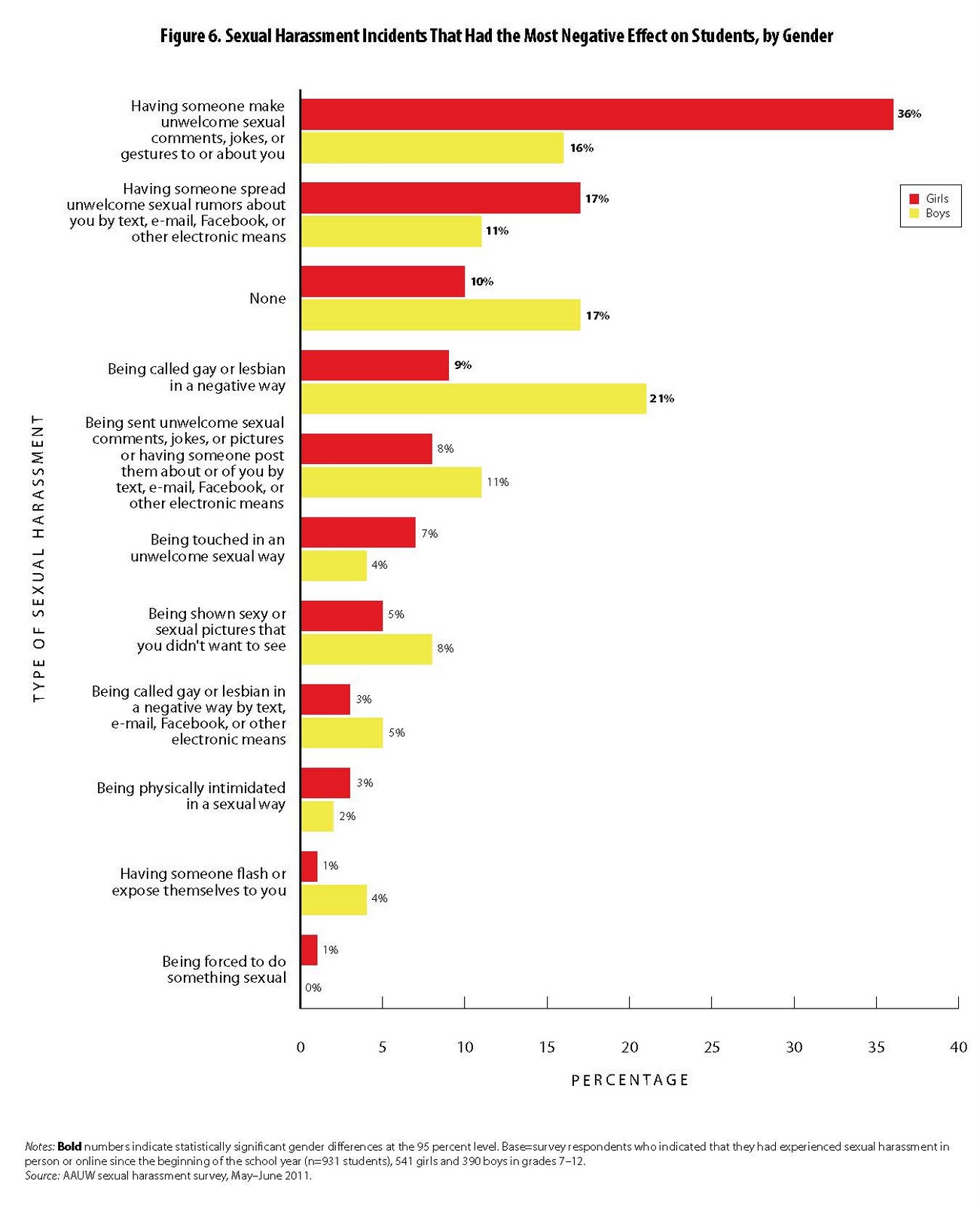
Report: The Commonplace nature of Sexual Harassment in grades 7-12


Crossing The Line:
Based on findings from a nationally representative survey conducted in May and June, 2011, this report presents the most comprehensive research to date on sexual harassment in grades 7-12 and reveals some sobering statistics about the prevalence of sexual harassment and the negative impact it has on students' education.
The report concludes with concrete recommendations and promising practices for preventing sexual harassment directed at school administrators, educators, parents, students and community members. We hope readers will be inspired to take new steps toward making schools free from sexual harassment.
AAUW has been at the forefront of sexual harassment research for over a decade, including the 1993 Hostile Hallways survey and the 2001 follow up report, Hostile Hallways: Bullying Teasing and Sexual Harassment in School.

Report